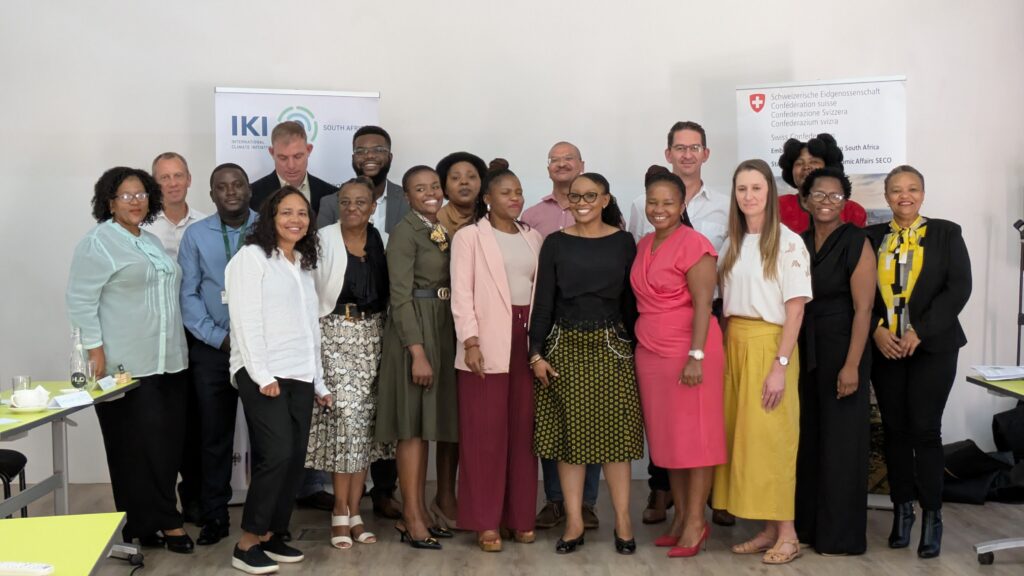
Second LCCR Roundtable Brings Together National Stakeholders and Partner Municipalities for Collaborative Water Action Towards Climate Resilience
16 June 2025

The Deutsche Gesellschaft für Internationale Zusammenarbeit (GIZ) GmbH, in collaboration with the Department of Water and Sanitation (DWS), is implementing the Low Carbon and Climate Resilient Water and Wastewater Management Project (LCCR Water). The project is funded by the German Federal Ministry for Environment, Nature Conservation, Nuclear Safety and Consumer Protection (BMUV) and the State Secretariat for Economic Affairs (SECO) of the Swiss Confederation.
LCCR Water plays a pivotal role in advancing South Africa’s national goals for low-carbon development and climate adaptation within the water sector, with a strong emphasis on delivering long-term solutions that directly address the needs of vulnerable communities. To achieve this, the project bridges the gap between national authorities and local municipalities, fostering collaboration and enabling practical solutions through partnerships with DWS and other sector departments.
By targeting persistent challenges faced by the water sector, the project is implementing both technical and management interventions in two selected municipalities, City of uMhlathuze and George Local Municipality. These initiatives aim to create replicable solutions that can be adapted and scaled to other regions across the country.
On 10 April 2025, LCCR Water hosted a roundtable discussion with representatives from partner municipalities and sector departments. The discussion provided a platform to introduce the project’s focus areas, engage national stakeholders, and establish connections to identify collaboration opportunities.
The two municipalities presented their ongoing activities supported by GIZ through the LCCR Water project, including water-loss reduction and conservation, stormwater management for flood alleviation, water reuse, non-sewered sanitation in informal settlements, energy efficiency in wastewater treatment, and water-tariff management.
Sessions were organized around topic-specific presentations, providing ample time for feedback, immediate responses, and the identification of support or collaboration opportunities. Stakeholders were encouraged to consider the relevance of each initiative to their organizations, share knowledge of funding or support opportunities, and suggest similar projects for peer learning or scaling up. This structured approach ensured active participation and helped explore potential partnerships to enhance the project’s impact.
Alongside key departments such as DBSA-Water Partnerships Office (WPO), National Treasury, Municipal Infrastructure Support Agent (MISA), the Sanitation Directorate of DWS, and the Water Research Commission (WRC), Ms. Mochoti, the Deputy Director-General of the Water Resource Directorate at DWS, shared valuable insights into South Africa’s water sector.
Moving forward, an agreement was reached to hold further bilateral discussions with DBSA-WPO and to actively involve the sanitation department of DWS in LCCR Water’s non-sewered sanitation initiatives.